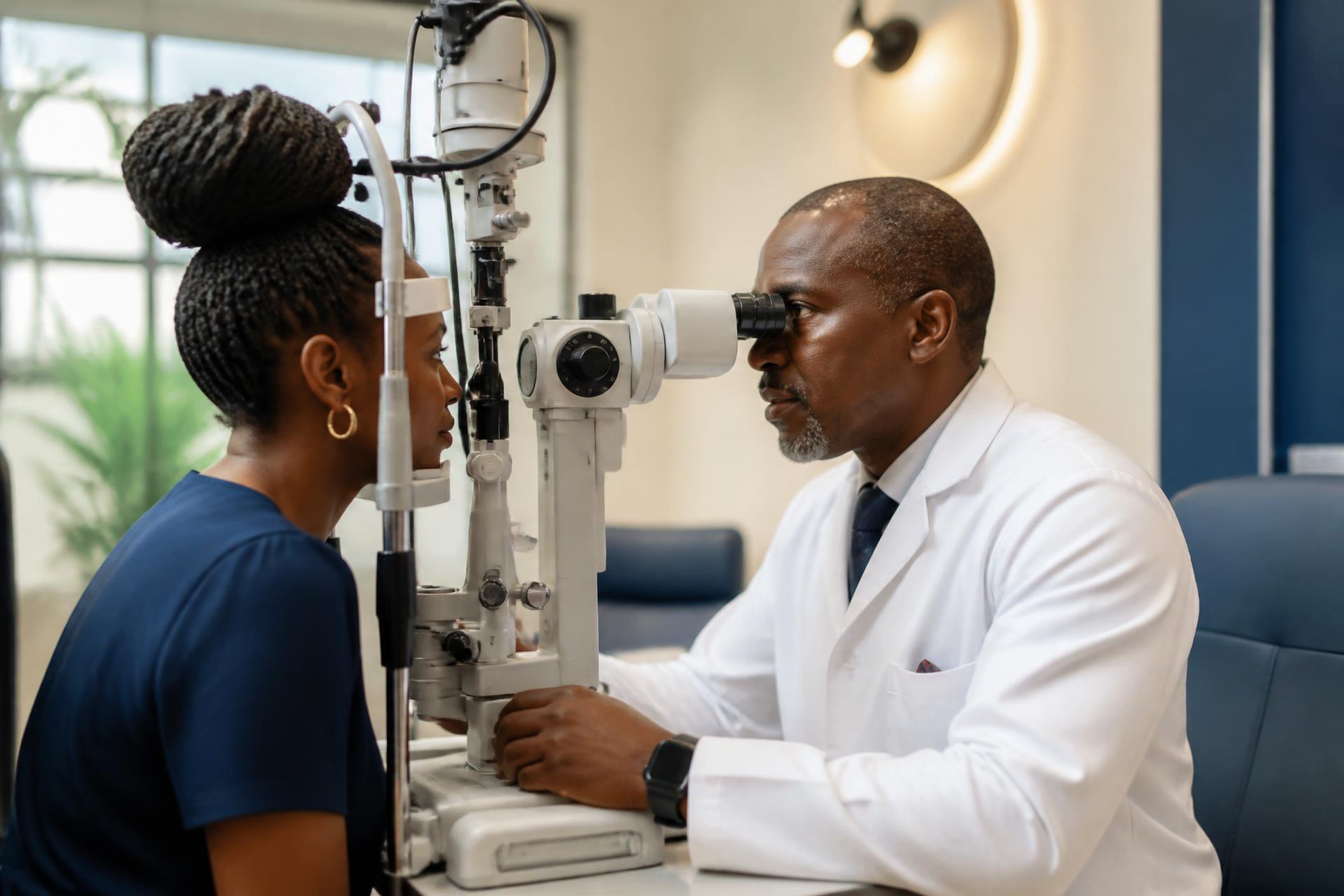
Sight-Saving Glaucoma Care
Glaucoma Service
Glaucoma damages the optic nerve silently, usually without pain, and the vision lost cannot be recovered. What is saved is the vision you still have — which makes early detection everything.
We run a structured glaucoma service: accurate pressure measurement, corneal thickness correction, structural imaging of the optic nerve and repeatable visual field testing — reviewed together at every visit.
Types of glaucoma
Primary Open Angle Glaucoma
The most common form in Nigeria. Painless, gradual loss of peripheral vision, often strongly familial.
Angle Closure Glaucoma
Drainage angle blockage. Acute attacks cause severe pain, redness, haloes and vomiting — attend immediately.
Secondary Glaucoma
Raised pressure caused by trauma, inflammation, advanced cataract, steroids or previous surgery.
Normal Tension Glaucoma
Optic nerve damage despite pressures in the normal range, requiring careful monitoring and lower targets.
Diagnostic tests
OCT of the Optic Nerve
Measures nerve fibre layer thickness to detect damage before field loss.
Visual Field Analysis
Maps functional vision loss and tracks progression over years.
Intraocular Pressure (IOP)
Applanation tonometry — the gold standard measurement.
Pachymetry
Corneal thickness, needed to interpret your pressure readings correctly.
Treatment options
Eye Drops
First-line therapy, tailored to your target pressure, tolerance and daily routine.
Laser Therapy
Laser trabeculoplasty or iridotomy to improve drainage and prevent angle closure.
MIGS
Minimally invasive glaucoma surgery — smaller incisions, faster recovery.
Trabeculectomy
Creates a new drainage pathway for reliable long-term pressure control.
Glaucoma Drainage Devices
Implants for complex or previously operated eyes.
If a parent or sibling has glaucoma, your risk is significantly higher. Screening from age 35 is strongly advised.
Not sure which clinic you need?
Book a comprehensive eye examination — we will guide you to the right specialist.